BTView: behavior trees you can actually review
#btview#behavior-trees#vscode#tooling
A behavior tree you can only read as XML is a behavior tree nobody reviews carefully. <Fallback> nested three deep inside a <Sequence> nested inside another <Fallback> is completely unambiguous to a parser and nearly unreadable to a person — which in practice means the review happens by trusting the diff, not by actually understanding what the tree does. For anything that’s orchestrating a real mission, that’s a trade I don’t want to make.
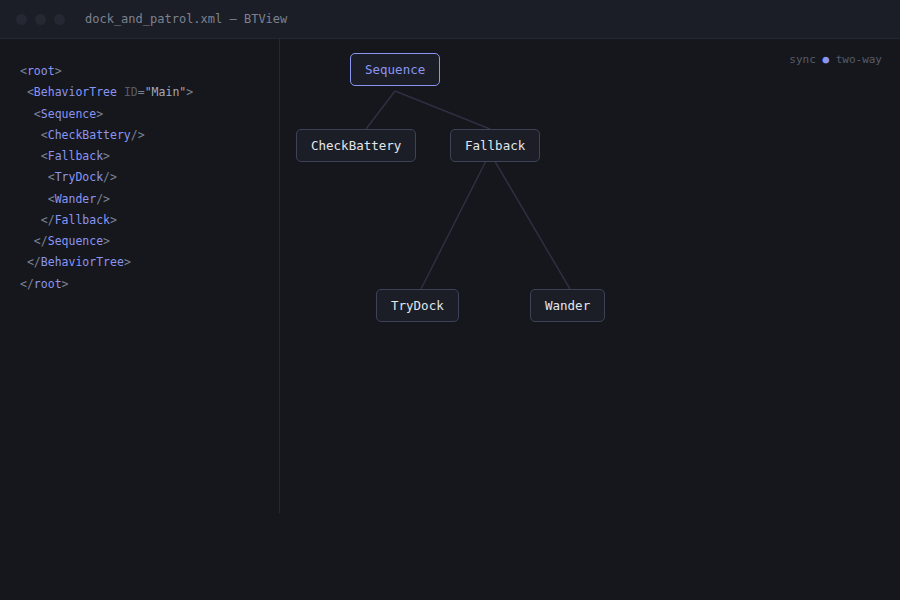
(that’s a mockup I put together to show the shape of the thing — the repo doesn’t ship any real screenshots yet, which is on my list)
BTView is a visual graph editor for BehaviorTree.CPP v3.8 and v4 trees, and it lives directly inside VS Code and Cursor rather than being yet another app you have to alt-tab into.
What it actually does
- Bidirectional XML sync — edit the graph, the XML updates; edit the XML, the graph updates. Neither view is the “real” one you have to remember to regenerate.
- Tidy tree layout — parents centered over their children, so a subtree reads as a unit instead of a pile of crossing lines.
- A full keyboard workflow — arrow-key navigation, search with match cycling, rename, copy/paste, undo/redo. There’s a cheat sheet if you press
?. - Node glyphs for the composite types —
→Sequence,?Fallback,⇉Parallel,↻Retry — so you can read the shape of a tree before you’ve parsed a single node name. - A validation panel that jumps you straight to the offending node, instead of making you grep the XML for whatever the linter’s complaining about.
- Both formats — it auto-detects v3.8 vs v4, and can migrate v3 to v4 with a diff preview so you’re not just trusting it.
It’s on the VS Code Marketplace, and since Cursor uses Open VSX rather than Microsoft’s marketplace, it’s there too: Open VSX.

I built this mostly because I was tired of reviewing behavior trees by squinting at diffs. If the tool for reading a tree back is worse than the tool for writing it, the tree just rots quietly and nobody notices until it’s wrong in production.